
Micron: An AI Train Running Too Fast
Lately, readers keep asking me the same question: is it still safe to get on board with Micron?
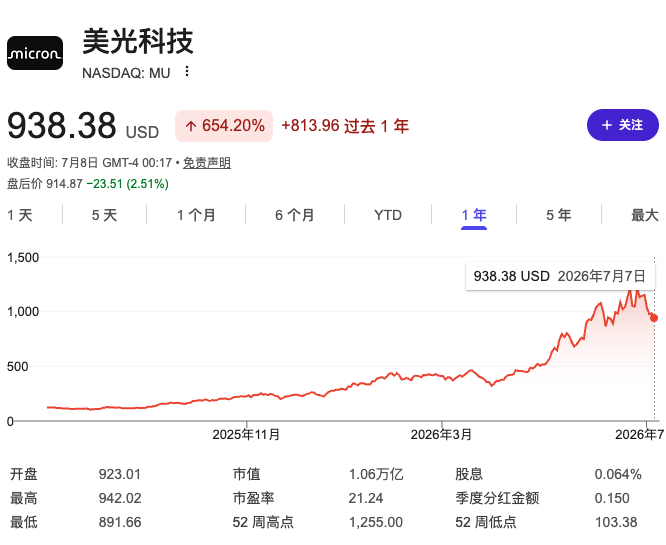
Honestly, this stock's ride over the past six months has been more dramatic than most shows I watch. At the start of the year it was drifting around $100-something. By late June it had surged to an all-time high of $1,255, with its market cap briefly crossing $1 trillion — making it the second memory-chip company ever to enter that club, after Samsung. And then? In less than two weeks, the stock pulled back more than 20% from the peak, and it's now churning around the $900 level.
One narrative calls it "the crown jewel of the AI supply chain"; the other calls it "a textbook roller coaster." Both are hanging on the same stock at the same time. So today, let's talk about whether this train is still worth staying on.
1. The Earnings Really Are Spectacular — No Debate There
Let me start with the conclusion: Micron's latest quarterly numbers are genuinely stunning.
Revenue more than tripled year over year to over $40 billion, far ahead of market expectations. Non-GAAP gross margin hit roughly 85% — a year ago that figure was below 40%. The company's guidance for next quarter is even more striking: revenue approaching the $50 billion mark.
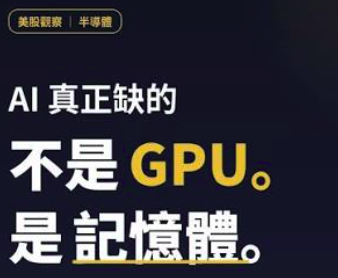
The core driver comes down to one word: HBM (high-bandwidth memory).
This is the critical memory that pairs with GPUs from NVIDIA, Google, and others inside AI servers. (I'll find a chance to write a proper explainer on HBM soon.)
Micron's HBM capacity for this year is fully booked — sold out into early next year. The company has also signed multi-year strategic supply agreements with Ford and General Motors, locking in revenue visibility even further. Management itself says that more than half of future revenue will come from binding long-term contracts like these. In an industry historically infamous for boom-and-bust cycles, that is remarkably rare.
No wonder a UBS analyst raised their price target from $535 straight to $1,625, arguing that the HBM supply-demand imbalance is "structural and durable" and that Micron deserves an NVIDIA-style valuation premium.
2. So Why Did the Stock Fall Anyway?
If the fundamentals are this good, why is the stock down more than 20% from its high? I've sorted through it, and the pressure comes from four directions:
First, the classic "sell the news" script. On June 24, the night earnings were released, the stock jumped as much as 15% — then spent the following weeks grinding lower. Textbook buy-the-expectation, sell-the-fact.
Second, Michael Burry publicly shorting it. Yes, the man behind The Big Short. In early July he published a piece on his Substack calling Micron "a textbook case of a cyclical stock," arguing this AI-driven surge is more FOMO sentiment than sustainable fundamentals. A short call from someone with that much reach does real short-term damage to sentiment.
Third, the clash of titans between Samsung and SK Hynix. Samsung's latest quarterly results were strong, but instead of boosting confidence, they made investors worry that the memory industry is heading into another round of everyone-expands-at-once. On top of that, SK Hynix plans to raise nearly $29 billion on Nasdaq through depositary receipts — effectively telling the market that competitors in this race are also expanding furiously and raising cash to grab share.
Fourth, insider selling plus an ongoing antitrust class action. None of these is fatal on its own, but landing all together, they became the straw that broke short-term sentiment.
3. The Old Cyclical Question: Is It Really Different This Time?
This is the most interesting part of the whole story — and where bulls and bears argue the loudest.
The bull case: HBM's share of total DRAM revenue is still rising fast, with some analysts projecting it could reach 40–50% by 2028. Once HBM becomes the core of Micron's revenue mix, earnings volatility should naturally decline, because HBM orders are mostly multi-year, fixed-price contracts — no longer at the mercy of the spot market like traditional DRAM. Goldman Sachs has also estimated that this year's DRAM supply-demand gap is the most severe in 15 years.
The bear case: Micron, SK Hynix, and Samsung are all aggressively expanding capacity in roughly the same window. The new fabs in New York and the Korean production lines will most likely come online together in 2027–2028. If by then AI models are improving efficiency faster than compute demand grows (say, inference costs fall sharply), supply floods in while demand doesn't keep up — and a price war could break out in no time. Within Goldman itself, one analyst has a price target around $400, among the most cautious voices in the market, with a blunt rationale: today's high margins are a cycle peak, not a new normal.
Personally, I think both arguments hold up — the difference is just the time horizon. Over the next year or two, AI capex and the HBM shortage are very real, and Micron's results will likely keep beating expectations. But looking beyond 2027, it's simply too early to conclude that the old laws of the capacity cycle have truly been broken.
4. My Take
At its core, Micron is a stock where two identities are fighting each other: "the certainty of AI infrastructure" versus "the cyclicality of memory chips."
If you believe AI compute demand will keep exceeding expectations and HBM scarcity can hold for another two or three years, then every sentiment-driven pullback — short-seller headlines, competitors' earnings, insider selling — could be a window to build a position. After all, the multi-year fixed-price contracts have written the next two years of revenue certainty into legally binding agreements, which is fundamentally different from the purely cyclical crashes of 2018 and 2022.
But if you're being drawn in purely by the thrill of a stock that's up six or seven times in a year, a word of caution: this stock now swings hard — down 5–6% in a single day is routine. It's not something to chase with money that can't stomach violent drawdowns.
Decades of memory-industry history keep proving the same thing: the steeper the rally, the wider the disagreement. With Micron this time, the real question isn't whether to get on the train — it's how long you plan to ride, and whether you can handle the turbulence along the way.
This article is shared as personal investment research only and does not constitute investment advice. Markets carry risk; invest with caution. Data as of July 8, 2026.
— Jindou
📮 Subscribe
Get new articles in your inbox. Unsubscribe anytime.
© MindCapitalAI · All rights reserved. Please credit and link when reposting.